1. Report Overview
With the large-scale implementation of generative AI, large model training, and intelligent computing clusters, the global computing power industry has achieved explosive growth, completely reshaping the traditional power consumption structure. As the core productive force of the digital economy, computing power requires high-density, all-weather, and high-intensity operation, generating a rigid demand for massive and stable power supply. This has driven a sharp increase in global power demand and expanded regional power shortages across the world.
The extreme pressure on power loads has set unprecedented stringent standards for the safety, stability, and fault tolerance of global power transmission and distribution networks. Currently, the continuous expansion of global power grid coverage and increasingly complex operation scenarios have exposed prominent shortcomings of traditional manual and mechanical obstacle removal modes, including large power outage losses, low operation efficiency, high safety risks, and high maintenance costs. Traditional operation and maintenance capabilities can no longer adapt to the power grid support requirements in the computing power era, and the grid obstacle removal dilemma has become a core bottleneck restricting stable power supply and the further expansion of the AI industry. Based on authoritative industry data, this report deeply analyzes the global power supply and demand pattern and core pain points of power grid operation and maintenance driven by AI computing power, and puts forward the intelligent solution of laser obstacle remover, providing professional reference for the intelligent upgrading of power grids and consolidating the power guarantee foundation for the computing power industry.
2. Rapid Expansion of AI Computing Power Driving Explosive Growth in Global Power Demand
Different from the stable power consumption mode of traditional civil and industrial sectors, AI computing power clusters are characterized by ultra-high power consumption, instantaneous high load, and 24-hour uninterrupted power consumption. This feature has completely changed the power consumption structure of data centers and power terminals, become the core driving force for the increment of global power consumption, and pushed the global power consumption into a rapid growth cycle.
2.1 Core Authoritative Data on Global Computing Power Power Consumption
1. Leapfrog growth in overall power consumption scale. According to public data from the International Energy Agency (IEA), the total power consumption of global data centers reached 415TWh in 2024, accounting for 1.5% of the total global social power consumption. It is expected to soar to 945TWh by 2030, equivalent to the annual power consumption of Japan. The power consumption scale will double from 2024 to 2030, with a growth rate far exceeding that of traditional power-consuming industries.
2. AI computing power dominates the incremental power consumption. The power consumption proportion of traditional general computing in data centers continues to decline, while AI training and inference loads have become the main power consumers. In 2024, AI loads accounted for only 15% of global data center power consumption, and the proportion is expected to rise sharply to more than 40% by 2030, exceeding 60% in leading supercomputing centers and intelligent computing centers. Forward-looking calculations show that the total power consumption of global data centers will exceed 1000TWh by 2026, among which AI computing power loads will account for one-third, becoming the absolute main force of data center power consumption.
3. Ten-fold increase in single-machine power density. The power consumption of a single cabinet in traditional general data centers is only 6-24kW, while the power consumption of AI intelligent computing cabinets surges to 60-240kW due to high-density GPU stacking and high-intensity computing, representing a more than 10-fold increase in power consumption. The peak power consumption of a super-large AI intelligent computing center can reach hundreds of megawatts, equivalent to the total power load of a medium and small-sized city, bringing far greater pressure on power concentration and instantaneous load fluctuation than traditional power operation scenarios.
4. Expanding global power gaps and full pressure on developed economies’ power grids. Industry calculations by Morgan Stanley show that current super-large global computing clusters and data centers have formed a rigid power gap of 55GW, and the power transmission and supply capacity of existing power grids cannot match the expansion speed of the computing power industry. From a regional perspective, the power consumption increment of U.S. data centers will account for nearly 50% of the national total power consumption increment from 2024 to 2030. By 2030, the power consumption of U.S. AI data processing will surpass the total power consumption of traditional high-energy-consuming industries such as steel, cement, and chemical engineering. The power consumption increment of data centers in Japan and the European Union accounts for more than 50% of their national power demand increments, keeping regional power supply and demand in a long-term tight balance.
5. Rising proportion of computing power energy consumption in the industry. Industry forecasts indicate that the power consumption of global GPU computing clusters will account for 3.2% of the total global power consumption by 2030. The AI computing power industry will officially rank among the world’s core emerging high-energy-consuming industries, with long-term persistent pressure on power guarantee.
2.2 High-load Computing Power Scenarios Force Power Grid Operation and Maintenance Upgrading
Traditional power grids are designed for stable, low-fluctuation civil and traditional industrial power consumption scenarios, and cannot adapt to the instantaneous high load, continuous full-load, and 24-hour uninterrupted power consumption characteristics of AI computing power clusters. Under the ultra-high load operation of computing power, power grid faults such as voltage fluctuations, instantaneous tripping, and local power outages caused by hidden line dangers will directly lead to the shutdown of computing power clusters and interruption of computing tasks. A single fault can cause direct economic losses of hundreds of thousands to millions of yuan, plus indirect losses such as suspended computing power projects and delayed data computing, resulting in extremely high economic costs. Therefore, normalized, uninterrupted, and zero-hidden-danger power grid operation and maintenance has become the underlying core guarantee for the stable development of the AI industry.
3. Core Dilemma of Global Power Grid Operation and Maintenance: Traditional Obstacle Removal Modes Fail to Adapt to the Computing Power Era
With the large-scale expansion of global power grids, high-voltage and ultra-high-voltage transmission lines cover complex areas such as mountains, forest areas, and urban-rural fringe areas, resulting in frequent hidden dangers in line channels. The backward technology and operation logic of traditional obstacle removal modes are seriously incompatible with the high stability, zero-shutdown, and high-efficiency operation and maintenance requirements of power grids in the computing power era, becoming a common core pain point and shortcoming in the global power industry.
3.1 Frequent Hidden Dangers of Power Grid Lines and Magnified Fault Destructiveness
At present, the total length of global high-voltage transmission lines of 35kV and above exceeds 2.3 million kilometers, with complex and variable operation environments. External obstacles are the primary cause of power grid faults, mainly divided into three core hidden dangers. First, prominent tree-line conflicts. The rapid growth of vegetation around lines in mountainous and forest areas leads to insufficient line safety distances, which are prone to discharge, short circuit, and tripping under severe weather such as thunderstorms and strong winds, ranking as the top cause of distribution network faults. Second, frequent floating foreign matters. Plastic films, kites, advertising cloths, bird nests, weeds and other floating objects winding high-voltage wires easily cause phase-to-phase short circuits and equipment breakdown faults, with such foreign matter tripping accidents accounting for 22.7% of annual total line faults. Third, highly recurrent hidden dangers. The natural growth speed of vegetation far exceeds the traditional obstacle removal speed, and most stubborn hidden danger points in mountainous areas require repeated obstacle removal more than 5 times a year, leading to rising ineffective operation and maintenance costs.
Compared with traditional power consumption scenarios, power grid faults in AI high-load computing power scenarios have strong chain effects. Power outages and fluctuations caused by tiny line hidden dangers will not only affect basic civil and industrial power consumption, but also directly lead to the paralysis of large-scale computing power clusters, resulting in geometric amplification of industrial losses.
3.2 Four Core Pain Points of Traditional Obstacle Removal Modes
1. Mandatory power outage operation causing huge computing power economic losses. Traditional manual and mechanical cutting obstacle removal requires cumbersome processes including power outage application, scheduling shutdown, and on-site safety isolation. A single conventional obstacle removal operation takes more than 4 hours. Long-term planned power outages are completely incompatible with the 24-hour uninterrupted operation core demand of AI computing power clusters, becoming the biggest operation and maintenance bottleneck restricting the stable implementation of the computing power industry.
2. High-altitude high-risk operation with prominent safety hazards. Traditional obstacle removal relies heavily on manual pole climbing and close-range live high-altitude operation, involving dual risks of high-altitude falling and high-voltage electric shock. Mechanical operation in complex terrain such as mountainous and forest areas is prone to mistakenly touching wires and damaging power equipment, triggering secondary power grid faults. Meanwhile, conventional UAV inspection has more than 10% non-navigable operation areas, unable to achieve full coverage of hidden danger investigation and removal, leaving a large number of operation and maintenance blind spots.
3. Low operation efficiency failing to meet high-frequency operation and maintenance needs. Traditional obstacle removal features large labor input, cumbersome processes and long operation cycles. The disposal of a single complex tree or foreign matter hidden danger takes up to 240 minutes. Faced with massive and repeatedly breeding line hidden dangers across the network, the obstacle removal efficiency is far lower than the hidden danger generation speed, making it impossible to achieve normalized, high-frequency and full-coverage hidden danger elimination.
4. High comprehensive operation and maintenance costs and serious resource waste. The traditional mode requires continuous investment of a large amount of labor, mechanical equipment and scheduling operation and maintenance resources. Superimposed with intangible costs such as repeated obstacle removal, fault maintenance and power outage losses, the overall operation and maintenance cost remains high, and it cannot fundamentally solve the problem of recurrent hidden dangers, resulting in extremely low operation and maintenance cost performance.
4. Core Industry Breakthrough Solution: Laser Obstacle Remover — A Must-Have Intelligent Operation and Maintenance Equipment for Power Grids in the Computing Power Era
In response to the core operation and maintenance requirements of zero power outage, high safety, high efficiency and full coverage for power grids in the computing power era, the laser obstacle remover completely subverts the traditional manual and mechanical obstacle removal modes with the technical advantages of non-contact, live-line operation and long-distance accurate obstacle removal. It perfectly solves the global power grid obstacle removal dilemma and becomes the core intelligent equipment adapted to high-load computing power power supply scenarios.
4.1 Core Working Principle
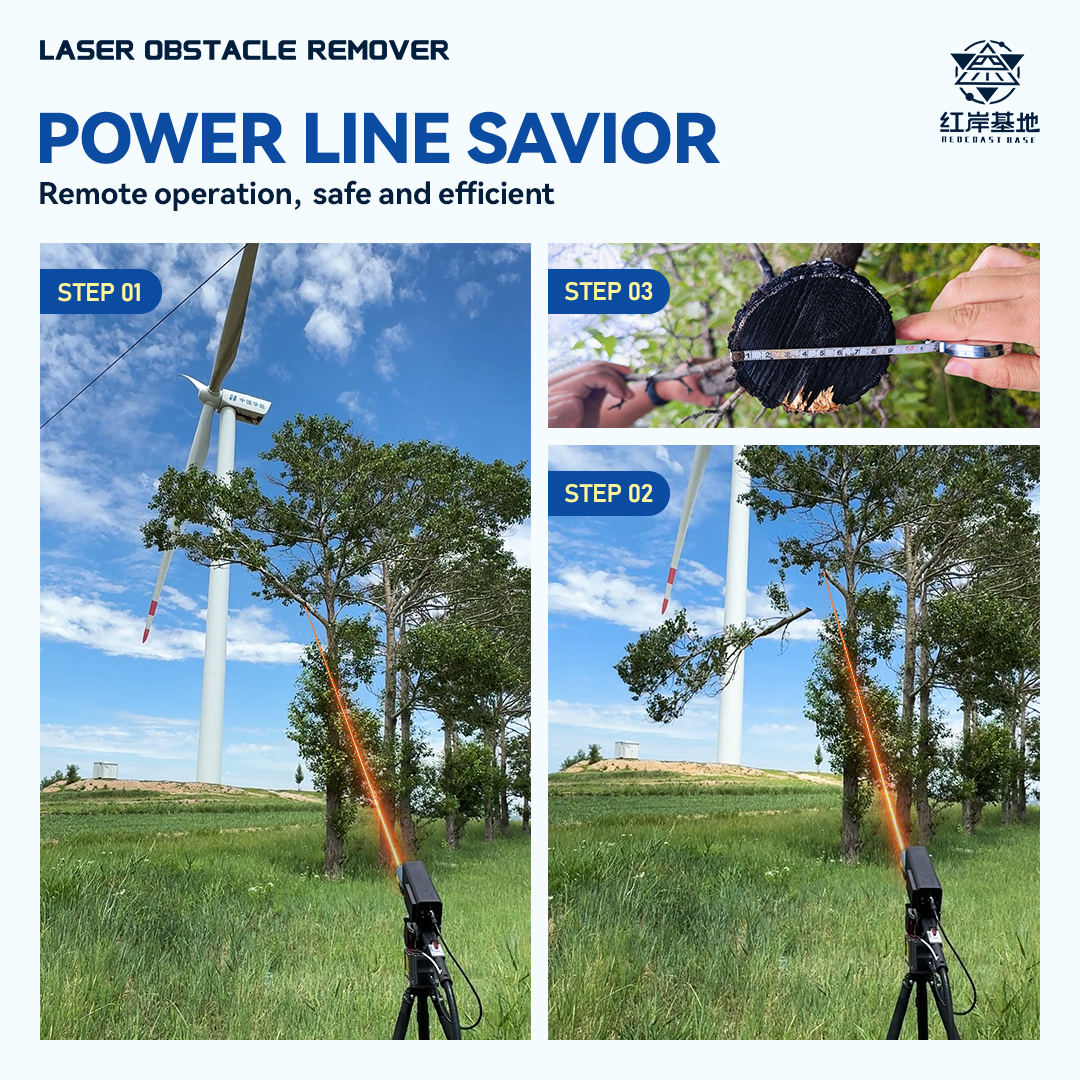
The laser obstacle remover adopts high-precision solid-state laser focusing technology, combining dual action mechanisms of photothermal ablation and plasma impact, and is equipped with a high-definition visual high-precision aiming system. It can accurately lock various obstacles such as tree barriers, floating foreign matters, bird nests and weeds on transmission lines from a long distance. With a special laser wavelength exclusively adapted to power grids, it can quickly ablate, cut and remove line hidden dangers without contacting wires or damaging insulators and power equipment. It realizes full-process intelligent obstacle removal with live-line, long-distance and non-contact operation, fully adapting to power grid operation and maintenance tasks of all voltage levels and complex scenarios.
4.2 Core Technical Advantages and Measured Efficiency Data
1. Full live-line operation with zero power outage loss. No power outage application, scheduling shutdown or power load interruption is required. Obstacle removal operations can be completed under the state of full-load power grid operation and normal computing power operation of AI clusters, completely eliminating computing power economic losses caused by power outages, accurately matching the core demand of uninterrupted power supply for the computing power industry, and solving the biggest pain point of traditional obstacle removal.
2. Greatly improved operation efficiency adapting to high-frequency operation and maintenance. Measured data shows that simple hidden dangers such as conventional floating foreign matters and thin branches within 100 meters can be completely removed in as fast as 30 seconds. The disposal time of a single complex stubborn hidden danger is shortened from 240 minutes to less than 60 minutes, the operation efficiency is increased by 18 times compared with the traditional mode, and the overall operation time is reduced by 75%. It can quickly complete the elimination of hidden dangers across the full power grid, perfectly adapting to high-frequency and normalized operation and maintenance needs.
3. Long-distance non-contact operation with zero safety risks. The maximum effective operation distance of the equipment reaches 650 meters, equipped with a 66x optical zoom + 10x digital zoom high-precision aiming system to accurately lock tiny hidden danger points. The whole-process long-distance non-contact operation completely eliminates the risks of manual high-altitude electric shock and falling. Built-in multiple protection mechanisms including body induction, safety interlock and 0.03-second ultra-fast emergency shutdown ensure that the special laser wavelength for power grids will not damage wires and insulation equipment, with no secondary fault risks.
4. Full-scenario adaptation and reduced comprehensive operation and maintenance costs. The equipment is lightweight, portable and easy to operate, adaptable to all complex terrains such as mountains, forests, wilderness and urban areas, supporting all-weather day and night operation without UAV non-navigable blind spots. It does not require continuous investment of a large number of labor and mechanical equipment. One-time equipment investment can be reused for a long time, greatly reducing comprehensive operation and maintenance costs such as repeated obstacle removal, fault maintenance and power outage losses, and significantly improving operation and maintenance cost performance.
4.3 Industrial Application Cases and Practical Effects
1. Normalized regional power grid operation and maintenance case (Yunfu Power Supply Bureau). Throughout the year, the laser obstacle remover was used to handle 327 hidden dangers including line tree barriers and floating foreign matters, reducing cumulative planned power outage time by more than 1,500 hours. It effectively guaranteed the power supply stability of regional computing power supporting power grids and 200,000 surrounding users and enterprises, and greatly improved power grid power supply reliability.
2. High-voltage line operation and maintenance case (Chaozhou Power Supply Bureau of China Southern Power Grid). In the operation and maintenance of 220kV high-voltage substations and transmission lines, the laser obstacle remover replaced traditional manual obstacle removal, reducing single-batch operation time by 75% with thorough hidden danger elimination. No subsequent power grid faults caused by similar hidden dangers occurred throughout the year, significantly improving the operation stability of high-voltage power grids under high load.
3. Emergency fault disposal case (Shanghai Rail Transit). For the fault of balloon strings winding on high-altitude contact wires, the laser obstacle remover completed rapid obstacle removal in only 5 minutes, successfully avoiding major accidents such as rail transit suspension and regional power fluctuations, with emergency disposal efficiency and safety far exceeding traditional operation modes.
5. Summary and Industry Outlook
The explosive growth of the AI computing power industry has pushed the global power demand into a new stage of exponential growth. The high-density, uninterrupted and high-fluctuation computing power load has set unprecedented stringent standards for power grid safety and stable operation. The inherent shortcomings of traditional obstacle removal modes, including large power outage losses, low efficiency, high risks and high costs, have become the core bottlenecks restricting stable power supply and high-quality expansion of the AI industry, making the intelligent upgrading of global power grids imperative.
As the core equipment for new-generation intelligent power grid operation and maintenance, the laser obstacle remover has completely innovated the traditional obstacle removal operation mode, realizing intelligent obstacle removal with no power outage, high efficiency, high safety, low cost and full coverage. It accurately adapts to the high-load, high-stability and high-frequency operation and maintenance requirements of power grids in the computing power era. Against the background of global power shortage and escalating power grid operation and maintenance pressure, the laser obstacle remover will become a must-have equipment for power grid intelligent upgrading and dual stability guarantee of computing power and power supply, with broad global market application prospects, building a solid power safety foundation for the sustainable and rapid development of the digital economy and AI industry.
 8th Generation Laser Obstacle Remover - RFE-1000B